In the last two decades, "online visibility" had a singular definition: ranking on the first page of Google. If you weren't in the top ten blue links, you didn't exist.
Today, that definition is obsolete. A silent but rapid migration is occurring: consumers are moving from searching for links to asking for answers.
For marketing leaders, this shift from traditional Search Engine Optimization (SEO) to Generative Engine Optimization (GEO) is not merely a technical update; it is a survival imperative. As AI models like ChatGPT, Perplexity, and Google's Gemini become the primary gatekeepers of information, brands that fail to optimize for these "Answer Engines" risk becoming invisible to their highest-intent customers.
Here is the business case for investing in AI visibility now, backed by market data.
1. The Volume Is Shifting (And It's Permanent)
The era of typing keywords into a search bar and sifting through results is ending. Consumers increasingly prefer the synthesized, direct answers provided by Large Language Models (LLMs). This is not a future trend; the migration is already underway.
- The Search Exodus: Gartner predicts that by 2026, traditional search engine volume will drop by 25%, with market share lost to AI chatbots and virtual agents [1]. If your marketing strategy relies solely on traditional search volume, you are fighting for a rapidly shrinking pie.
- The Consumer Pivot: A recent report revealed that 58% of consumers have already replaced traditional search engines with AI tools for product and service discovery [2].
- Mass Gatekeeping: Google's AI Overviews now reach over 2 billion users monthly. When a user queries Google, they are increasingly likely to see an AI-generated summary before they see your website link.
The Insight: Spending on GEO is no longer "experimental." It is a defensive necessity to retain access to the majority of digital consumers.
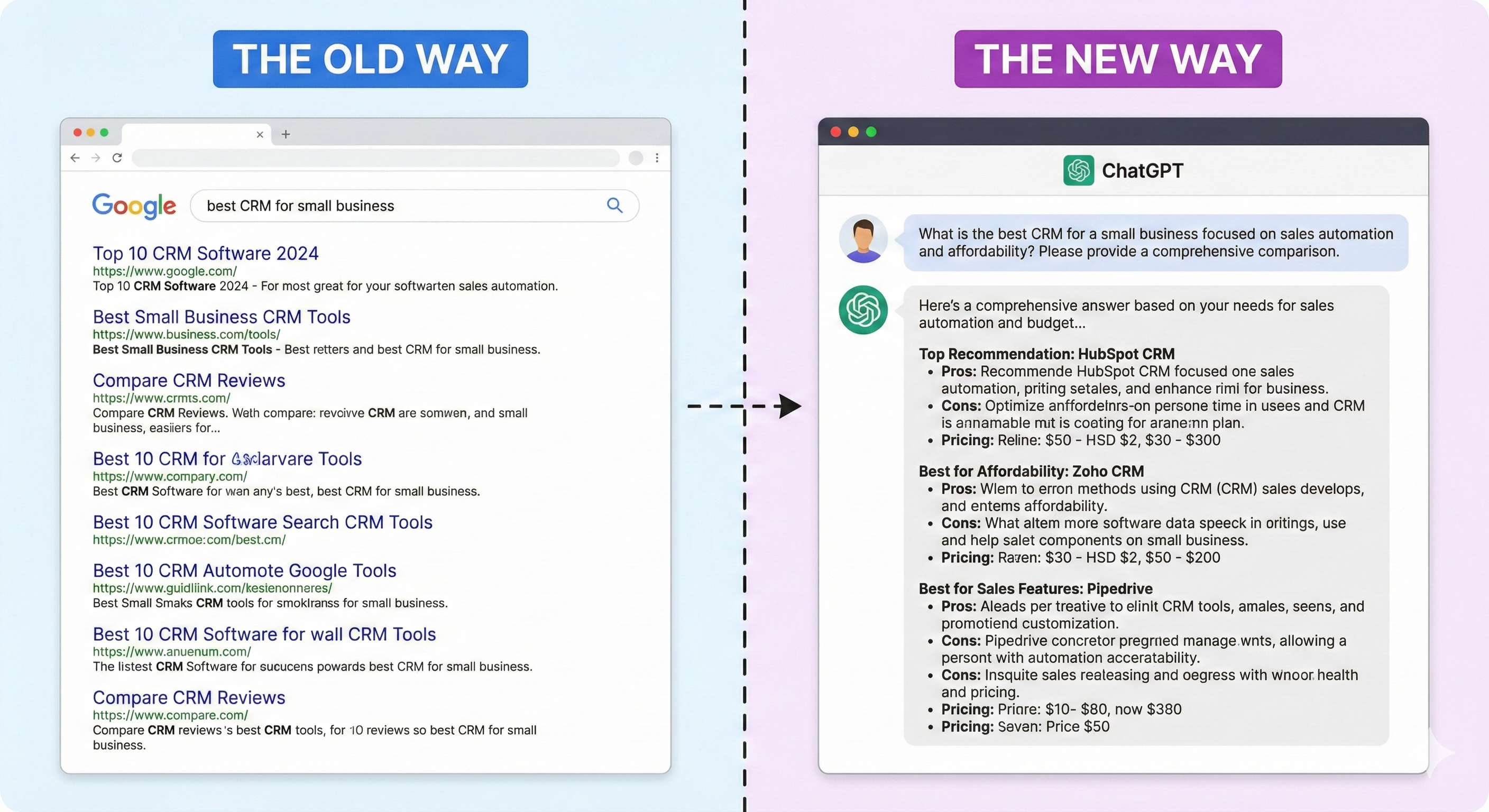
2. The "Zero-Click" Reality: Being the Answer vs. Being the Link
In the traditional SEO model, the goal was to earn a click to your site. In the AI era, the goal is to be cited in the answer. AI platforms are designed to satisfy user intent without sending them elsewhere. This is the rise of the "Zero-Click" environment.
- The Traffic Tax: Data indicates that when an AI Overview appears for a search query on Google, the click-through rate (CTR) for the top-ranking organic result drops by approximately 34.5% [3].
- Intercepting Intent: Even specific, branded searches are being intercepted. Recent data shows that over 10% of navigational queries (searches intended to find a specific site) now trigger AI overviews that answer the question before the user clicks the brand link [4].
The Insight: If your brand data is not fed into the AI's answer, you do not just lose a click—you lose the customer entirely to a competitor who was cited.
3. Higher Intent and Better Conversion
While traffic volume from AI might be lower than the traditional search firehose, the quality of that traffic is significantly higher. Users turn to AI for complex decision-making, placing them deeper in the funnel.
- Trust Drives Sales: Contrary to early skepticism, users trust AI recommendations. Studies indicate that 64% of customers express readiness to purchase products suggested by AI bots [2].
- The Conversion Multiplier: Because AI qualifies the user through conversation before suggesting a solution, traffic originating from AI search is highly qualified. Reports suggest AI search traffic can convert at up to 4.4x the rate of traditional organic search.
The Insight: AI optimization is a high-yield investment. The user asking ChatGPT "What is the best CRM for scaling a mid-sized fintech company?" is ready to buy, not just browse.
4. Brand Mentions Are the New Backlinks
How does a brand rank in an AI model? Not through keywords or just backlinks, but through "Entity Authority" and probabilistic association. AI models recommend brands that are consistently associated with specific positive attributes across the web.
- The Correlation Signal: Research by Ahrefs found a strong 0.664 correlation between brand mentions across the web and appearing in AI Overviews—a far stronger signal than traditional link metrics [3].
- The Visibility Gap: Brands that fall into the top quartile for total web mentions achieve nearly 10x more visibility in AI results than their competitors with fewer mentions.
The Insight: Marketing spend must shift from technical link-building to Digital PR and "Brand Salience." You must ensure your brand is cited in the authoritative sources (news, whitepapers, expert reviews, databases like G2/Crunchbase) that the AI models are trained on.
Your Action Plan: The "Share of Model" GEO Framework
You cannot optimize what you do not measure. To pivot from SEO to GEO, marketing leaders need a new operating system. We call this the "Share of Model" (SoM) Framework.
While "Share of Voice" measured how loud you were in the market, Share of Model measures how deeply entrenched your brand is in the AI's training data and retrieval logic.
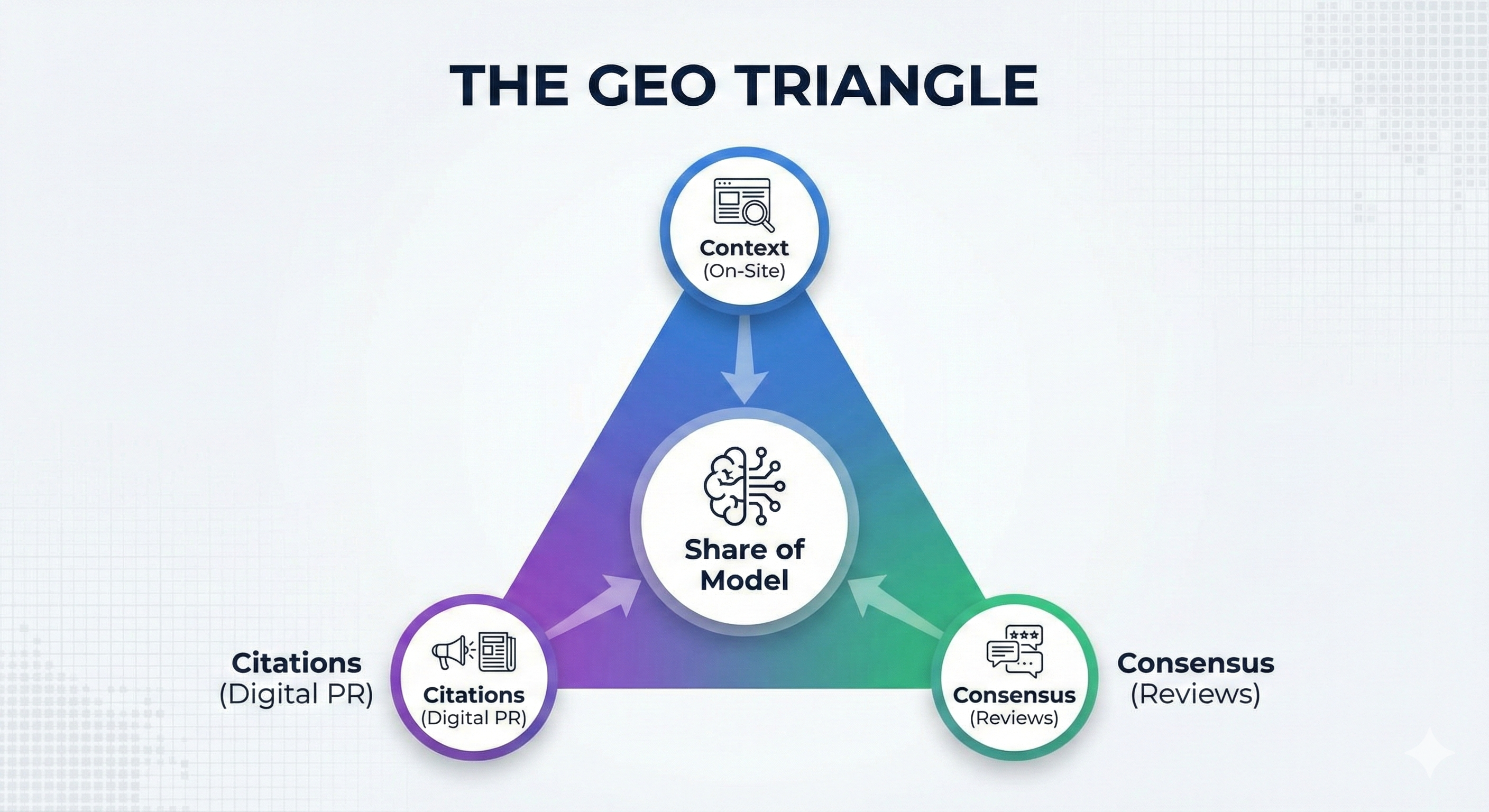
Here is a 3-step framework to audit and improve your AI visibility:
Phase 1: The "Golden Prompt" Audit
Stop tracking keywords; start tracking questions. Your audit must replicate the actual questions your high-intent buyers are asking.
Step 1: Define Your 20 "Golden Prompts": Identify the complex questions that lead to a sale (e.g., comparing competitors, solving specific pain points, or asking for "best of" lists in your niche).
Step 2: The "Incognito" Test: Run these prompts through the "Big Three" engines: ChatGPT, Perplexity, and Google Gemini. Do this in fresh sessions to avoid history bias.
Step 3: Score Your Visibility: For each prompt, assign a score:
- 0 (Invisible): Not mentioned.
- 1 (Listicle): Just one name in a list of ten.
- 2 (Shortlisted): In the top 3 recommendations with context.
- 3 (Recommended): Explicitly cited as the best solution or "source of truth."
Phase 2: The Optimization Pillars (The 3 Cs)
Once you know your score, use the "3 Cs" to improve it. Unlike SEO, GEO is about Context, Citations, and Consensus.
1. Context (On-Site Optimization)
AI models prioritize content that answers questions directly.
The Tactic: Restructure high-value pages into an "Answer-First" format. Start sections with a direct question (H2 tag) followed immediately by a concise, factual answer (30-50 words). This makes it easy for the AI to "scrape and cite" your definition.
2. Citations (Digital PR)
AI models verify facts by cross-referencing authoritative third-party sources.
The Tactic: Focus on Digital PR. Get your brand mentioned in the sources AI trusts: major news outlets, niche industry reports, and reputable directories. If Perplexity sees your brand mentioned in TechCrunch and a G2 report for the same attribute (e.g., "best enterprise security"), it solidifies that "fact" in its knowledge graph.
3. Consensus (Review Signals)
AI reads the "sentiment" of the web to understand why people like you.
The Tactic: Audit your reviews on third-party sites. If users consistently mention "slow support," the AI will summarize your brand that way. Actively campaign for reviews that use the specific keywords you want associated with your brand (e.g., "fast ROI," "easy implementation").
Conclusion: The Cost of Invisibility
The data is clear: the digital shelf is being reorganized. The winners of the next decade will not be the brands with the best keyword stuffing, but the brands that have trained the AI models to know who they are, what they do, and why they are the best.
Investing in AI visibility is not just about capturing traffic; it is about teaching the world's most powerful engines that your brand is the correct answer to your customer's question.
Sources Cited:
- Gartner Report: "Predicts 2024: Search Engine Volume to Drop 25% by 2026 due to AI Chatbots."
- Capgemini Research Institute, "Total Immersion: How Immersive Experiences and AI are Reshaping Consumer Behavior" (2025 data).
- Ahrefs Study on AI Overview Impact and Brand Mentions correlation.
- Semrush Sensor Data on Navigational Query interception by AI.
Measure Your Brand's Share of Model
Want to understand how AI systems currently represent your brand across ChatGPT, Perplexity, and Google Gemini? Schedule a conversation to learn more about AI Visibility Intelligence.
Schedule a Conversation